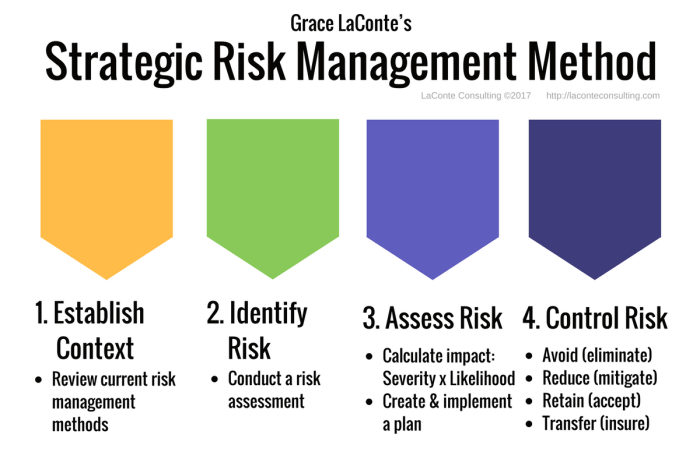
Amidst the dynamic landscape of business risks, Strategic Risk Management emerges as a crucial tool for organizations seeking stability and growth. Let’s delve into the realm of strategic risk management to uncover its intricacies and strategic significance.
As we explore the nuances of strategic risk management, we will unravel its key components, risk assessment processes, management strategies, and the critical role of risk tolerance in decision-making.
Introduction to Strategic Risk Management
Strategic risk management is a crucial process in business that involves identifying, assessing, and managing risks that could potentially impact the achievement of organizational objectives. It focuses on the risks that can threaten the overall strategic goals of a company.
Unlike traditional risk management, which mainly deals with operational and financial risks, strategic risk management looks at the bigger picture and considers risks that could affect the long-term viability and success of the business. It takes into account external factors such as market trends, regulatory changes, and competitive landscape.
Key Components of Strategic Risk Management
- Identification of Risks: This involves systematically identifying potential risks that could impact the organization’s strategic goals. It includes both internal and external factors that could pose a threat.
- Assessment of Risks: Once risks are identified, they need to be assessed in terms of their likelihood and impact on the business. This step helps prioritize risks based on their severity.
- Risk Mitigation Strategies: After assessing the risks, organizations need to develop strategies to mitigate or manage these risks effectively. This may involve implementing control measures, transferring risks, or avoiding them altogether.
- Monitoring and Review: Risk management is an ongoing process that requires constant monitoring and review. Organizations need to regularly assess the effectiveness of their risk management strategies and make adjustments as needed.
Risk Assessment in Strategic Risk Management
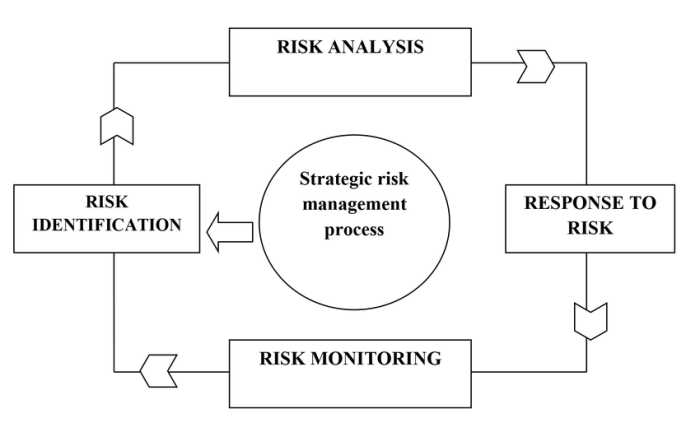
Risk assessment is a crucial step in strategic risk management that involves identifying, analyzing, and evaluating potential risks and opportunities that may impact an organization’s objectives. By assessing risks, organizations can proactively plan and implement strategies to mitigate or capitalize on them.
Tools and Techniques for Risk Assessment
- SWOT Analysis: A strategic planning tool that helps identify an organization’s strengths, weaknesses, opportunities, and threats.
- PESTLE Analysis: An analytical tool used to identify external factors that may impact an organization, including political, economic, social, technological, legal, and environmental factors.
- Risk Register: A document that records identified risks, their potential impact, and planned responses.
- Scenario Analysis: A technique that involves analyzing different scenarios to understand potential outcomes and their likelihood.
- Delphi Technique: A method that involves gathering expert opinions to reach a consensus on potential risks and their impact.
Risk assessment plays a key role in helping organizations identify potential risks and opportunities that may affect their strategic objectives. By conducting a thorough risk assessment, organizations can develop risk mitigation strategies, allocate resources effectively, and make informed decisions to enhance their resilience and competitiveness in a dynamic business environment.
Risk Management Strategies
When it comes to managing risks strategically, organizations have various strategies at their disposal to effectively mitigate potential threats and uncertainties. By implementing the right risk management strategies, companies can safeguard their operations, reputation, and financial stability.
Proactive vs. Reactive Risk Management
Proactive risk management involves identifying and addressing potential risks before they materialize, allowing organizations to take preventive measures and minimize the impact of adverse events. On the other hand, reactive risk management responds to risks after they have occurred, focusing on containment, damage control, and recovery.
Alignment with Strategic Objectives
Risk management strategies can align with an organization’s strategic objectives by integrating risk considerations into decision-making processes, resource allocation, and goal setting. By aligning risk management strategies with strategic objectives, companies can enhance their resilience, adaptability, and long-term sustainability.
Risk Tolerance in Strategic Risk Management
Risk tolerance refers to the level of risk that an organization is willing to accept or take on in pursuit of its strategic objectives. It plays a crucial role in strategic risk management as it helps organizations determine the amount of risk they are comfortable with and can afford to bear.
Determining and Measuring Risk Tolerance Levels
In order to determine and measure risk tolerance levels, organizations need to consider factors such as their overall risk appetite, financial capacity, regulatory requirements, industry standards, and stakeholder expectations. Risk tolerance levels can be quantitatively measured using metrics such as maximum loss thresholds, percentage of revenue at risk, or key risk indicators.
Relationship between Risk Tolerance, Risk Appetite, and Risk Capacity
Risk tolerance, risk appetite, and risk capacity are interrelated concepts that influence strategic decision-making. Risk appetite represents the amount of risk an organization is willing to take to achieve its objectives, while risk capacity refers to the organization’s ability to absorb and manage risk effectively. Risk tolerance acts as a bridge between risk appetite and risk capacity, helping organizations strike a balance between taking on too much risk and being overly cautious in their decision-making processes.
In conclusion, Strategic Risk Management equips businesses with the foresight and resilience to navigate uncertainties effectively, ultimately steering them towards sustainable success amidst a volatile environment.
Query Resolution
What is the difference between strategic risk management and traditional risk management?
Strategic risk management focuses on aligning risks with strategic objectives, while traditional risk management primarily deals with minimizing risks without strategic alignment.
How are risk tolerance levels determined in an organization?
Risk tolerance levels are typically determined through a combination of quantitative analysis, stakeholder input, and risk appetite assessments.
What are some examples of tools used for risk assessment in strategic risk management?
Tools such as SWOT analysis, scenario planning, and risk heat maps are commonly used for risk assessment in strategic risk management.


